Jump to Section
The impact of AI on Digital Preservation and archiving in 2026: Are you ready?

AI is no longer experimental in archiving and records management. It’s becoming part of daily work and as digital content grows, so do the pressures around access, compliance, security and cost.
Working closely with customers and industry experts, Preservice is seeing a clear set of priorities take shape, driven not by predictions but by the real operational challenges organizations are facing today. These priorities are deeply interconnected and AI is influencing them all, including how digital information is managed, secured, preserved and made accessible for the long term.
The question for 2026 is no longer whether AI will impact Digital Preservation, because it already has.
The real question is whether your archiving and Digital Preservation strategy and your technology partners are ready for what that means in practice.
Below, we explore five key priorities shaping Digital Preservation in 2026 and how intelligent archiving and AI-powered Active Digital Preservation are helping organizations move from reactive preservation to resilient, future-ready stewardship of their digital assets.
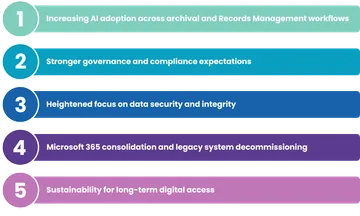
The five priorities shaping Digital Preservation success in 2026 include:
1. Increasing AI adoption and readiness
Many organizations are already beginning to move beyond experimenting with AI and are starting to use it in practical, well-governed ways. This will rapidly increase during 2026 as AI becomes a seamless part of everyday Digital Preservation workflows.
Preservica is focused on supporting this shift by embedding AI tools directly into preservation and archiving workflows. These capabilities help organizations reduce backlogs, improve metadata quality and make long-term content easier to find, freeing teams to focus on higher-value work as AI becomes part of everyday operations.
Feedback from Preservica’s AI in Digital Preservation Workshop Series reinforces the importance of human oversight. As Martyn Simpson, Preservica’s Chief Information Security Officer, noted:

That focus on transparency and human oversight reflects what we see in real customer deployments and why preservation-grade controls, such as chain-of-custody and data-integrity safeguards, are essential when applying AI at scale. You can learn more about Preservica’s current capabilities on AI-Powered Archiving here.
Preservica will continue to expand its roadmap by enhancing existing product capabilities with human-centered AI assistance that will help accelerate and streamline tasks such as identifying sensitive information, improve search and discovery and automate tasks such as transcription, image analysis and content classification. These tools are designed to work together within a governed preservation environment, with human oversight built in from the start. Watch for upcoming announcements as we take the next steps in making AI a trusted, everyday part of Digital Preservation practice.
2. Stronger governance and compliance expectations
Expectations around oversight and compliance are becoming central to how Digital Preservation programs are evaluated and trusted. Regulatory requirements are sharpening, AI-related standards are taking shape and organizations face closer scrutiny over how long-term data is managed, accessed and used.
For information managers, this means responsibility extends beyond policy. It includes clear controls, accountability and ongoing review.
Just as importantly, this is not something one team can manage alone. Effective oversight depends on sustained collaboration across information management, IT, cybersecurity, legal and compliance functions. As long-term data and the technologies that interact with it continue to evolve, these groups must stay aligned to ensure decisions remain transparent, defensible and consistent over time. In this environment, strong governance becomes the foundation for confidence in both day-to-day operations and long-term preservation strategies.
“Archivists and Records Managers are going to play a critical role in ensuring authenticity, provenance, transparency and trust in digital records, while AI can automate many functions like searchability and metadata creation, human oversight still remains essential. So it really is an opportunity to adapt and elevate the work that you do to a more strategic level within digital preservation, and it extends to your role in AI governance and coming forward to engage your stakeholders on AI policies and standards."
Martyn Simpson, Preservica CISO
What stronger AI governance looks like in practice
In practical terms, stronger governance in 2026 requires organizations to be explicit and intentional about:
- Where AI is used, and where it should not be applied
- What data AI can access, including personal, sensitive, or regulated records
- How AI outputs are reviewed, with defined human-in-the-loop controls
- Which laws and standards apply, from GDPR and UK-GDPR to the EU AI Act and emerging national frameworks, such as Australia’s Guidance for AI Adoption (GfAA)
- How vendors handle data, including data sovereignty, security controls and model training practices
Digital Preservation provides the foundation for this level of oversight by ensuring long-term data remains authentic, traceable and secure. Controls such as chain of custody, integrity checks and access management enable the explanation and defense of how data is used over time, supporting both compliance and confidence in AI-driven outcomes.
Preservica continues to invest in this area by closely tracking evolving regulations and standards and applying them through clear internal AI policies. These focus on transparency, security, data jurisdiction and human oversight and will continue to evolve through 2026.
To help organizations translate governance principles into action, Martyn led the development of the Preservica AI Guidelines at a Glance as a guide to documenting and managing AI use across key areas, including:
- Purpose and scope of AI use
- Data trust, provenance and quality
- Legal, ethical and regulatory alignment
- Human oversight, risk assessment and accountability
- Ongoing monitoring, transparency and review
Together, these practices help organizations move beyond ad hoc controls toward a model that supports innovation with AI while protecting trust, compliance and long-term accountability.
3. Greater focus on data security and sovereignty
Data security and sovereignty are also priority areas for Digital Preservation. High-profile incidents involving household brand names highlight a growing reality: as data volumes increase and AI becomes more deeply embedded in enterprise systems, the attack surface expands.
Organizations must address more than traditional cyber threats. AI-enabled attacks, ransomware and heightened scrutiny of data residency are raising questions about where long-term data is stored and whether AI workloads comply with jurisdictional and sovereignty requirements.
Understanding how AI interacts with preserved content and ensuring those interactions are secure by design will be essential to maintaining trust, resilience and compliance.
What stronger data security and sovereignty require in practice
A heightened focus on security and sovereignty means organizations must be clear about:

A preservation-grade archive isn’t just another operational system; it’s deliberately separated from live environments, where most threats occur. This separation, combined with always-readable, tamper-evident controls, helps safeguard critical records against cyberattacks and system failures while keeping long-term data accessible and trustworthy.
Preservica takes a secure-by-design approach to Digital Preservation, with security and sovereignty built into every layer of the platform. Guided by our CISO, we continuously track emerging threats and the cybersecurity implications of AI, using these insights to strengthen our Trust Center and evolve security controls as both technology and regulations advance.
A good example of this in action is Preservica’s work with The National Archives UK. Here, Digital Preservation supports long-term access to national records while aligning with the UK government’s cloud-first policy. By pairing secure cloud infrastructure with preservation-grade controls, Preservica helps ensure sensitive historical and public records remain accessible and trusted, without compromising sovereignty, integrity, or resilience.
4. Microsoft 365 consolidation and legacy decommissioning
As Microsoft 365 and SharePoint become the primary systems of record, organizations face a growing challenge in 2026: managing long-term content without adding cost, risk, or complexity. While Microsoft 365 is built for collaboration and active work, a significant share of its content was never intended to remain there indefinitely. A reality that became clear in our Preserve365 Education sessions.
Approximately one-third of Microsoft 365 content requires long-term or permanent retention. Without a clear preservation strategy, this content quickly drives SharePoint sprawl, higher storage costs and mounting discovery and compliance challenges. Meanwhile, legacy systems and file shares continue to operate alongside Microsoft 365 - costly to maintain and increasingly hard to control.
Why consolidation becomes unavoidable
When long-term records are spread across SharePoint, legacy applications and file shares, the impact is immediate and measurable:
- Slower access and discovery, creating bottlenecks for legal, compliance and operational teams
- Growing volumes of dark data, reducing confidence in authoritative records
- Continued reliance on legacy systems, increasing cost and technical debt
- Delayed AI initiatives, due to inconsistent metadata, integrity gaps and limited context
Preservica addresses this by taking a consolidated Digital Preservation approach that works with Microsoft 365, not around it. Capabilities such as Preserve365 and universal search embed preservation directly into SharePoint workflows- automating the transfer of long-term records while keeping SharePoint lean, current and focused on active content.
To explore this approach in more depth, download the eBook: Unlocking the Value of Long-Term Microsoft 365 Content for Compliance and AI.
What a consolidated preservation model enables

By combining Microsoft-native tools with preservation-grade controls, organizations can:
- Automate archiving from Microsoft 365 using existing Purview retention and sensitivity labels
- Decommission legacy systems without losing access to historical records
- Preserve integrity and readability, ensuring content remains usable for decades
- Surface archived and legacy content directly in SharePoint using familiar permissions and search
- Unlock long-term data for compliance, audits and AI-driven discovery
Preservica continues to work closely with customers across industries to support this transition. Learn more by watching From Dark Data to Intelligent Discovery: How a Consolidated Digital Preservation Archive Transforms Microsoft 365 and reading this blog about Decommissioning Legacy Systems.
5. Sustainability for long-term digital access
Digital Preservation exists to protect integrity, continuity and accountability over time. But understanding why we preserve is only the starting point. The long-term value of preserved content depends on how it is sustained, which means looking beyond technology alone to the organizational stability, financial longevity and standards-based commitments of the preservation provider. As a result, many organizations are asking a more practical question: Can a preservation partner demonstrate long-term sustainability in a transparent and measurable way?
What sustainable preservation looks like in 2026
A sustainable approach now requires a holistic commitment that supports durability over the long term. Preservica’s Seven Principles for Sustainable Digital Preservation were developed with the community to reflect this broader view of what it takes to preserve digital content responsibly and reliably.
Sustainability is also closely tied to standards-based preservation. Alignment with globally recognized frameworks such as ISO 14721 (OAIS) and the NDSA Levels of Digital Preservation helps organizations avoid proprietary approaches and ensures preservation programs can adapt as requirements evolve.
Preservica has formalized this long-term responsibility through its independently ratified Sustainability Charter, developed with the community to make commitments transparent and measurable. This standards-first approach underpins Preservica’s Active Digital Preservation platform, ensuring content remains readable and trustworthy as formats, platforms and expectations change.
Sustainability and AI belong in the same conversation
As AI becomes more embedded in preservation and discovery workflows, sustainability increasingly includes scrutiny of environmental impact. AI workloads can increase cloud resource consumption, making efficiency and responsible operations essential.
Preservica is addressing these concerns by aligning with cloud providers that:

As we look to the future, AI processing efficiency is expected to improve significantly as chip manufacturers and LLM providers compete, driving more efficient architectures, lower energy consumption and more sustainable AI workloads over time.
Looking ahead
As AI becomes part of everyday archiving and Digital Preservation, success will be defined by how well organizations balance innovation with control. That means clear oversight, strong security and sovereignty and preservation strategies built to last.
Preservica will continue to strengthen governance, compliance and security across its platform, supporting sector-specific requirements, protecting AI-enabled workflows and keeping long-term content safely separated from operational systems. The aim is simple: help organizations move forward with AI confidently, without sacrificing trust in their digital records.
In the coming weeks, Preservica will introduce new built-in AI tools, making human-centered AI a seamless part of everyday Digital Preservation workflows for organizations of all sizes.
Let's chat
Have an informal conversation with our experts about unlocking the long-term value of your digital assets using human-centered AI.